Join the movement to end censorship by Big Tech. StopBitBurning.com needs donations and support.
Chinese Chipmakers Secure Three-Year ASML Stockpile as Huawei Coordinates Domestic Replacement Effort
By edisonreed // 2026-09-10
Mastodon
 Parler
 Gab
Gab Copy
Copy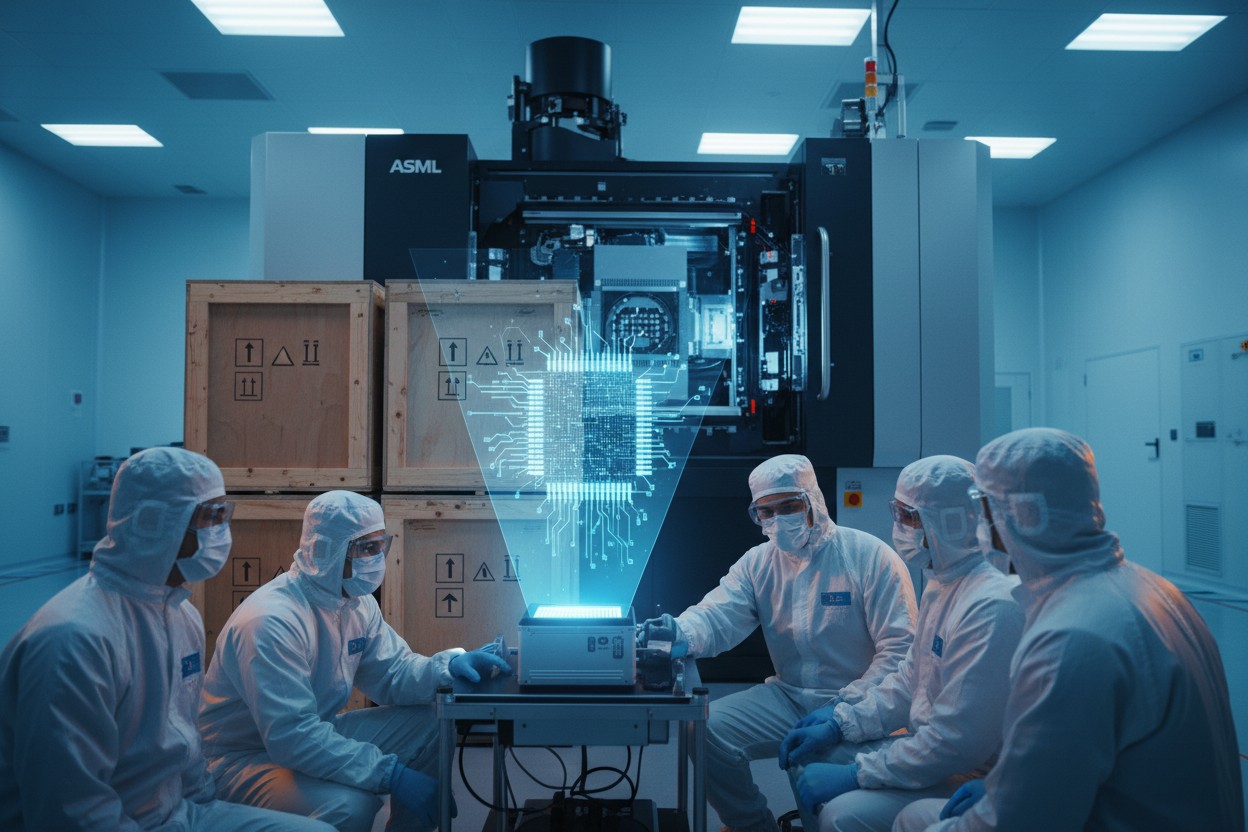
Chinese memory chipmakers CXMT and YMTC have acquired enough ASML lithography equipment to support their expansion plans for the next three years, according to a Financial Times report. The purchases serve as a buffer against potential U.S. restrictions that would bar sales of advanced Dutch chipmaking tools to China. The report also stated that Huawei has taken a coordinating role in a national effort to develop domestic deep-ultraviolet (DUV) scanners as a substitute for the ASML machines.
The domestic effort centers on a Shanghai startup named Yuliangsheng, whose immersion DUV scanner is currently being tested at SMIC, China's largest chipmaker, and on Huawei's production lines, according to the report. People familiar with the matter told the Financial Times that the machine will target 28-nanometer chips in a single pass and 7-nanometer chips using multi-patterning. Huawei has not publicly commented on its role, according to the report.
U.S. Export Controls and the MATCH Act
U.S. export controls have progressively tightened since October 2022, when the Biden administration restricted China's access to advanced Nvidia chips and American semiconductor manufacturing tools [1]. Subsequent rounds added high-bandwidth memory and a broader category of ASML chip-printing machines to the restricted list. Reuters reported earlier this year that the White House loosened some chip sales, licensing Nvidia H200 processors, but Congress has moved in the opposite direction regarding machinery. The Multilateral Alignment of Technology Controls on Hardware (MATCH) Act, H.R. 8170, was introduced in the House on April 2. Reuters reported that the bill would bar ASML from selling its immersion DUV machines to any buyer in China and require licenses for servicing equipment already installed there. The House Foreign Affairs Committee approved the substitute version of the bill by a 36-8 vote on April 22, but the measure has not yet received a floor vote in the House. A Senate version, S.4281, remains under consideration in the Banking Committee.Huawei's Project Management Role in Domestic DUV Development
According to the Financial Times, Huawei has taken a coordinating role in China's domestic lithography push, investing across the supply chain and pushing domestic tools into chip plants. One source told the paper that the Yuliangsheng scanner will reach 12 units of output by the end of the year. The startup was founded in 2022 and spun out of SiCarrier, a Shenzhen equipment maker. Huawei has denied any affiliation with Yuliangsheng, the report said. Bernstein analyst Lin Qingyuan told the Financial Times that "Huawei is playing a project management role in China's DUV push." Lin cautioned that a prototype has limited value without the thousands of vendors, fabricators, and customers needed to make it reliable at industrial scale. The effort includes Huawei's corporate venture arm Habo and a Huawei-backed fund, Shenzhen Yuanzhi Xinghuo, which have invested in suppliers working on critical components such as projection lenses and light sources.Stockpile of Dutch Machines and U.S. Component Dependence
CXMT and YMTC have purchased enough ASML DUV equipment to cover three years of expansion, according to the Financial Times. SMIC continues to use ASML tools for its production lines even while testing the Yuliangsheng scanner. Nearly 1,400 ASML machines were installed in China as of late 2023, according to ASML's China president. China purchased $49.6 billion in chip equipment in 2024, representing 42 percent of the global total, much of it bought ahead of anticipated export controls. The Yuliangsheng replacement machine prints wafers using projection lenses made by Germany's Zeiss. Zeiss has said it sells lithography optics to only one customer, ASML. The machine also depends on light sources from Japan's Gigaphoton or ASML's Cymer subsidiary, according to the Financial Times. A three-year supply of machines covers a potential sales ban, but it does not cover a servicing restriction, since immersion tools require maintenance approximately every six months, typically performed by ASML engineers at customer sites in China.Challenges and Potential Acceleration
Chinese suppliers remain behind in producing two of the hardest components in a DUV scanner: the projection lens and the light source, according to Financial Times sources. Huawei has backed Fujian Zhiqi Photonics, a company spun out of optical-materials maker Castech in 2022, to develop a replacement lens. The Huawei-backed fund Yuanzhi Xinghuo paid 100 million yuan for 37 percent of that company in 2023. Beijing RSLaser, also backed by Habo, has supplied light sources for Shanghai Micro Electronics Equipment's older machines and is developing one for the 28nm tool. Analysts noted that the three-year stockpile delays the production-line learning that domestic scanners need to mature. Lin told the Financial Times that U.S. restrictions could actually accelerate China's progress by forcing local fabs to work with local suppliers. "Huawei can coordinate the suppliers, fund the missing components and put prototypes in front of SMIC," Lin said. "What it cannot easily do is make a fab abandon a proven ASML scanner while Dutch inventory is still available."Outlook for China's Chip Independence
Reporters and analysts concur that Huawei's efforts have not yet persuaded major Chinese fabs to abandon ASML equipment while the stockpile remains available. SMIC, CXMT, and YMTC have all continued to rely on Dutch machines for production. The domestic scanner's dependence on foreign components, particularly Zeiss lenses, underscores that full independence has not yet been achieved, according to the Financial Times report. The three-year stockpile gives time for development, but progress depends on ongoing cooperation from vendors and the absence of a servicing ban, the report stated. The MATCH Act's status remains uncertain, pending a floor vote. The analysts' assessment, as quoted in the Financial Times, is that restrictions could force local fabs to cooperate with domestic suppliers and potentially accelerate China's push toward self-sufficiency in chipmaking equipment, though the timeline remains dependent on the machinery underneath China's expanding AI industry.References
- NaturalNews.com. "US officials to talk with Dutch counterparts about restricting exports of chip-making gear to China." NaturalNews.com. January 27, 2023.
- Zero Hedge. "After Blockbuster IPO, China's Memory Giant CXMT Plans Second Chip Plant In Beijing." August 3, 2026.
- Zero Hedge. "Huawei Touts Sanctions-Busting Chip Breakthrough, SMIC Shares Erupt." May 25, 2026.
- Mike Adams. "How Huawei Just Made Western Chip Technology Obsolete—and Why Sanctions Always Backfire." NaturalNews.com. May 29, 2026.
Mastodon
Parler
Gab
Copy
Tagged Under:
glitch artificial intelligence China AI cyber war innovation products chips supercomputer inventions NVIDIA information technology computing future tech supply chain trade wars superintelligence Western chip technology Nvidia AI chip
You Might Also Like

U.S. Bans Canadian Dairy, Alcohol and Motorcycle Imports as Trade Dispute Intensifies
By Douglas Harrington // Share

U.K. Study Links Ultra-Processed Foods to Accelerated Biological Aging
By Coco Somers // Share

Falling birth rates signal deeper crisis in human resilience, not just infertility
By Willow Tohi // Share
Chinese Oil Demand Surge Drives Shanghai Crude Above $100, Brent Approaches Key Level
By Sterling Ashworth // Share

CAR-T Cancer Treatment Draws Patients to China as Costs Rise in U.S.
By Morgan S. Verity // Share

Iron coffins: How $500 drones are burying the million-dollar tank
By Lance D Johnson // Share
Recent News




Four killed, including child, in Ukrainian drone attack on Russian Black Sea port
By isabelle // Share

Popular This Week