 Parler
 Gab
Gab Copy
Copy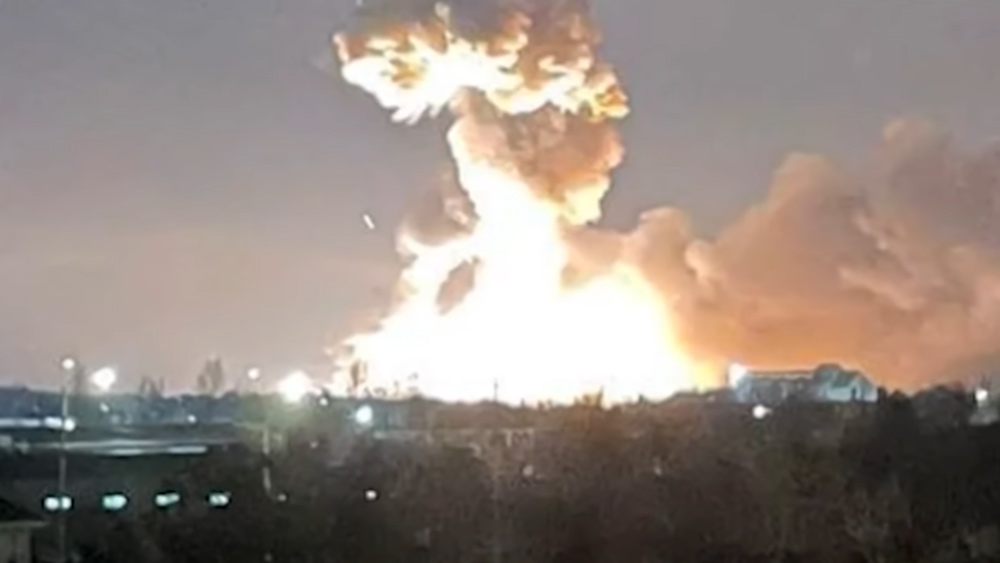
- Russia’s Tsirkon hypersonic missile has been used operationally in Ukraine, striking targets in Kyiv and elsewhere.
- The missile travels at speeds up to Mach 9, making it nearly impossible for current air defense systems to intercept.
- Nuclear capable and deployed on submarines, frigates, and ground launchers, the Tsirkon alters the balance of power in Europe.
- Western analysts admit the missile slows in its terminal phase to Mach 4.5, but even that speed overwhelms most defenses.
- Russian shipbuilders now equip Yasen-M class nuclear submarines with the missile on a regular basis, extending its reach globally.
The weapon that rewrites the rules of engagement
The Tsirkon missile represents a quantum leap in military technology, one that the Kremlin has been perfecting since at least 2017 when the first test firing occurred nearly a year ahead of schedule. By October 2020, the Admiral Gorshkov frigate launched a Tsirkon in the Barents Sea that reached Mach 8 and soared to an altitude of 28 kilometers. By February 2019, President Vladimir Putin boasted the missile could accelerate to Mach 9 and destroy targets within 1,000 kilometers. These are not abstract figures. They translate into a weapon that can strike any target in Europe within minutes, leaving no time for political deliberation or military reaction. What makes the Tsirkon particularly menacing is its flight profile. Unlike traditional ballistic missiles that follow predictable arcs, the Tsirkon maneuvers at hypersonic speeds inside the atmosphere. As it screams toward its target, a plasma cloud forms around the missile, absorbing radio waves and blinding radar systems. The weapon even blinds its own seeker, forcing it to slow to around Mach 4.5 in the terminal phase. Western analysts, including former Royal Navy Commander Tom Sharpe, admit this is when systems like the Patriot and SAMP/T might have a chance. But the window is razor thin, and the missile’s enormous kinetic energy ensures even a near miss can devastate a target. The Ukrainian Scientific Research Institute of Forensic Expertise conducted its own analysis of recovered Tsirkon wreckage in 2026 and discovered something startling. The missile appears to be a traditional ballistic or quasi-ballistic design using a two-stage solid rocket motor, not the scramjet engine long assumed by Western intelligence. This means Russia has achieved hypersonic speeds with a simpler, more reliable technology that is easier to mass produce. The implications for defense planners are catastrophic. Models built around intercepting cruise missiles or ballistic reentry vehicles fail against a weapon that behaves like neither.Deployment in Ukraine reveals strategic intent
Russia has not been shy about testing its new toy in combat. On February 7, 2024, the Tsirkon made its combat debut, striking targets in Ukraine. Less than two months later, on March 25, 2024, Russia launched two Tsirkon missiles from a ground-based launcher in Crimea, targeting decision-making centers in the heart of Kyiv. Russian state media reported both missiles hit their objectives, one a Security Service of Ukraine headquarters and the other Zhuliany airport. Ukrainian officials claimed both were intercepted, but photographic evidence of missile debris told a different story. The strikes that followed painted a more complete picture. In late March 2026, the Russian Defense Ministry announced a massive overnight barrage of precision-guided weapons from ground, sea, and air bases, along with unmanned aerial vehicles. The targets included a Kyiv factory that produced components and warheads for long-range Flamingo cruise missiles, a solid rocket fuel plant in Pavlograd, an oil refinery in Kremenchug, and port infrastructure in Odessa and Reni. A cargo ship carrying military supplies was also struck at the port of Odessa. What the ministry did not say explicitly, but what military analysts understand, is that the Tsirkon played a starring role in these strikes. Its speed and terminal maneuverability make it the ideal weapon for hitting hardened, high-value targets deep inside Ukrainian territory. Classified documents reveal Russia ordered 80 Tsirkon missiles annually for 2024 through 2026. United Shipbuilding Corporation CEO Alexei Rakhmanov confirmed in August 2023 that multi-purpose nuclear submarines of the Yasen-M project will carry the missile system on a regular basis. This means the Tsirkon is not a boutique weapon reserved for special occasions. It is becoming the standard armament for Russia’s most advanced naval platforms.What the Tsirkon means for Europe and the future of warfare
For European nations that have spent decades investing in missile defense systems designed to counter Soviet era threats, the Tsirkon represents an existential challenge. The missile’s range, estimated at 400 to 450 kilometers on average but extending to 1,000 kilometers in some configurations, covers virtually every capital city on the continent when launched from the Baltic, Black, or Barents Seas. When combined with Russia’s nuclear submarine fleet, the Tsirkon provides a first strike capability that can hold any target in Europe at risk with little to no warning. The weapon also exposes the hollow promises of NATO’s defensive posture. Alliance members have been told that systems like the Patriot, THAAD, and Aegis Ashore can protect them from missile attack. The Tsirkon proves otherwise. Its speed, maneuverability, and plasma stealth make interception a matter of luck rather than skill. Former Royal Navy Commander Tom Sharpe acknowledged that Patriot and SAMP/T systems might destroy a Tsirkon in its terminal phase when it slows to Mach 4.5, but that is like trying to catch a bullet with a butterfly net. The kinetic energy alone, even at reduced speed, can overwhelm a warship or destroy a building. The Tsirkon gives Russia a credible deterrent against NATO intervention in any future conflict. Any calculation of military risk must now account for the fact that Russian submarines lurking in the North Atlantic can strike targets in London, Paris, or Berlin within minutes. This fundamentally alters the calculus of escalation and makes the prospect of direct confrontation between nuclear powers even more dangerous. Sources include: SputnikGlobe.com Reuters.com KyivIndependent.com
Pentagon Database Omits Two U.S. Service Member Deaths in Middle East, Report Says
By Garrison Vance // Share
Saudi Arabia Seeks Missile Interceptors as Yemeni Attacks Strain Air Defenses
By Iva Greene // Share

The hidden ingredient: How common food additives may be silently depleting your health
By Ava Grace // Share

U.S. Refuses to Issue Visas to Members of Iranian President’s UN Delegation
By Douglas Harrington // Share

Trump Announces Greenland Security Agreement With Denmark; Text Not Released
By Belle Carter // Share

Data Center Boom Expected to Increase Semiconductor Demand and PFAS Use, Report Says
By Chase Codewell // Share

Macron fires back at Trump over AI map claiming French islands as U.S. territory
By isabelle // Share

It’s Not Panic Buying—It’s Preparedness: Why Smart People Are Stocking Up Now
By healthranger // Share


Being a Person of Principle Will Always Make You an Enemy of the State
By healthranger // Share

Brace For Impact: Diesel Costs Top $6.50 A Gallon Amid Worsening Supply Disruptions
By sterlingashworth // Share